Wednesday, 31 October 2012

Trying to use iPads, QR codes and Twitter with AS Media students

Last year's AS Media Induction went well and students got plenty of early practice; no doubt this helped them achieve so well in their coursework. The problem was that the theoretical side of things was a bit of a shock to the students' systems and we had to take chunks of time out of the portfolio weeks to teach some key concepts.

So we changed things a little. I decided to tackle questions of Representation straight away in my lessons, trying to incorporate basic deconstruction of media texts within the unit including camerawork and composition. My colleagues, with whom I share the classes, tackled an introduction to the film industry. This will hopefully help students deal better with some of their research and planning, and with their evaluation questions, as well as preparing them for the exam units which we usually really focus on once the coursework is out of the way. It makes sense. It connects the different parts of the syllabus. It is challenging.
I also wanted to incorporate the use of the iPads we purchased last summer to allow for more hands-on participation and peer-assessment alongside class discussion/direct instruction.

After much deliberation, I decided to focus on the representation of women in the media because, well, everyone is bound to have been exposed to that and most would have an opinion. Moreover, the Campaign against the Sun's page 3 was in full swing so it seemed to fit.

First triple lesson

Actually, I didn't start straight away. I introduced SOLO in the first 10 minutes of the lesson. I simply put the symbols on the board with some blu-tack, asked if they had any idea what they could represent (slipped the word semiotics and a brief explanation in there), then asked for one student at a time to come up and hold a sign. I used the volcano example probably with less brio than @learningspy in the video below but it made the point.


First introduction:
Pictures around the room - some examples below (some gathered together for the plenary) - plus post-its. Individually at first students were asked to jot down thoughts and questions about each one. On one table was a bit of information about Representation of women so that at some point they would be able to refine what they wrote on post-its and reconsider what they'd already written.

We brought it all back to the front around the cluster of desks and went through what they'd written. Great opening discussion following a lot of sweeping statements at this stage. We reach a fair understanding of what is meant by representation and stereotype and even started discussing ideas of fairness, feminism and patriarchy (though I won't pretend that they could have explained all these terms with clarity at that point). Some noted the playfulness of the woman's gaze staring at the reader on the Cosmopolitan cover - great way to introduce the notion of the male gaze!
Other points included the evolution of these representations over time to some extent but the issue of sexualisation/objectification of women is still clearly present.


A slide I 'borrowed' from another centre too long ago to give proper credit


We completed this section of the lesson, a consolidation of sorts, with the following pictures on one slide - again, it brought all the main points home! It also allowed us to start looking at (and introducing the concepts of) composition and mise-en-scene.


Here are a few slides that I didn't show but include here as they sum up what I wanted the students to consider by the end of the discussion.

To be honest, I didn't insist of the post-feminism bit... Plenty of time for that later.

Introducing the SOLO rubric:
I kept it nice and simple at that stage - no doubt it needs revision but it served us well for that first lesson.
Students were asked to identify what level they thought they were working at and what they needed to do next to progress further in their learning.


Second part:
Next we looked at an outrageous advert for a Russian airline company. We watched it together with one class but the IT failing us again with the other group, I was glad I had prepared a QR code to take us to it. The initial thought behind it was to allow students to watch it again in pairs on the iPads to deconstruct it properly at their own pace and screengrab different shots for later use, maybe with the Skitch app to annotate and comment (we didn't really do that in the end but I am definitely doing that next year - except that we will use Explain Everything, which at that point I hadn't had time to experiment with properly).
This is the QR code (incidentally, we used the i-nigma app to read the QR codes but I used Qrafter Pro to create them):
(For those without QR readers, the link takes you here)
The ad is explicit enough to allow for plenty of discussion and deconstruction. We also used the camera on the iPads to recreate some of the angles (and learn about shot distances and angles at the same time) and analyse their effects. 

Further discussion followed to consolidate knowledge of key terminology and messages peddled by such media texts. They had much to say at this point!!!

Third part - Some theory:
Introducing Berger seems a natural next step given the discussion so far. Here are a few slides I used to support the discussion and also printed for students to annotate further as part of their home-learning.

Ok, ok... These are A2 slides and yes, they flipped at the vocabulary on the last slide but we made a start at explaining the terminology. They need to find out more about these terms and make some notes as part of their home-learning.
This was a good time to go over Laura Mulvey's notion of the male gaze again.... gently.

Part 4:
The idea was to look further at some of the wider implications for the social groups affected by such representations - here, women of course.
I had a selection of articles and each had a QR code to allow students to read at least one at their own pace and jot down key points, questions and thoughts. However, time was running out.
In the end, we read straight from a paper copy of this article about the No More Page 3 campaign and I am glad we did as the vocabulary and ideas needed explaining.

Then in pairs they looked at/scanned one more article and fed back on key ideas - some examples are below:


Finally, and with not enough time left (surprise, surprise... there is just too much in this lesson), I asked students to record themselves discussing what they had learnt today using the camera on the iPads. Clearly, this would have needed more time and some redrafting/re-recording after peer-assessment but you just can't do everything, can you? At least they were happy to have a go.
A bit disappointing considering the quality of their contributions from half way through the lesson...

Instead, I told them I would upload the clips to the blog and expected them to leave comments on WWW and EBI/obvious gaps. I wasn't holding my breath as they had barely started their own blogs but since I really want more of this later on, I thought I'd start as I meant to go on.
The first batch of comments (those who managed) was really superficial and instructions about content had been ignored by and large. However we addressed that in the following lesson as we went through them. Better quality next time I hope!

Here's one here:

Home-learning and Independent study:
A list of short and longer tasks emerging from the lesson and a recommendation to read further by using some of the clips and links to further articles on the blog, including exploring the representation of women in music videos.

I did sort out a Scoop.it page by the following week to keep resources in one place here.

We finished the lesson by filling in the SOLO grids again. Most felt they had definitely moved to multistructural to relational but knew they would need to read and learn much more to feel really confident about the topic - not a bad thing to take away from the first lesson!


And what about Twitter?
I have run the department Twitter account for two years now and I know that not enough use is made of it by students, except perhaps before the exams when they are on the look out for relevant articles and revision tips. I want students to be more involved this year and most have signed up so far.

Well, one of the home-learning tasks was to tweet something about the topic using the hashtag #womenrep, perhaps focusing on one responding to the No More Page 3 campaign or some ideas from the lesson. The first hurdle was to get the students to sign up to Twitter!
Again, the result was pretty dreadful sweeping statement and one student commenting that "It's their choice to pose for page 3" but hey, this was all about having a go and finding our feet.

Following on from that, I thought that they needed exposure to more materials and opinions from other students (from other centres) so I asked 2 other departments if they would agree to have their own students use the same hashtag to post a few of their views. Luckily for us, they accepted and over the following 2 weeks, students tweeted a few more comments - much better in quality. The end result was to have a Tweetwall (I used twitterfall.com) in one of our lessons to go through some of them and respond/comment in class.

Unfortunately, a further IT glitch (it will get fixed at some point...) prevented me from displaying it on the IWB but I managed to read some tweets from my phone. Not great but next time will be better. At least I have finally got a lead to link the iPad to the projector!
I didn't think of taking a screengrab at the time... I should have!!! That would have saved us.
Here is what it looks like:


SO...
Not completely there yet but more like baby steps... The key is to embed all this so that it becomes second nature... a bit like blogging the coursework!

NB: I had also prepared this clip from friends which highlights how gender stereotypes are perpetuated.  I thought I might use it as a starter and I kind of wish I had but this triple was so over-prepared and resourced anyway, I had to leave bits out.


By the next lesson, the students were still struggling to articulate their thoughts really clearly but some progress was made, and the issue has much to do with the general level of Literacy. Our students only need a C in English to be allowed on the Media Studies course. I hope that by getting used to rehearsing orally what they need to say, better writing will follow (their essays in the 3rd lesson were actually quite good and incorporated some of the terminology).

Here's one group of students discussing the topic after looking at a few more sources.

Saturday, 18 August 2012

Hattie - Visible Learning

This is not mine but I have been reading this very useful PPT again. Going to keep it here for ease of access...
To be found here.


Friday, 17 August 2012

Pan's Labyrinth - Year 9 - part b) Thinking about the lesson obs

[NOTE: THIS POST WAS WRITTEN BEFORE THE NEW OFSTED FRAMEWORK. 
I felt it was too personal to be published at the time but now... Well I am investigating ways in which lesson observations are conducted in schools and looking at a range of lesson observation templates, most of which are just as complicated as our one - but I sure hope it won't be for much longer.]

Just a few observations on my inability to think straight when I am planning for an observation and leaving my instincts in the cupboard during the actual obs.

Now I have the good luck to have achieved several "Os" in recent lesson observations, but it always feels like luck rather than anything else. I do get that warm feeling when a lesson goes well and you feel on top of the world, but I don't think it's happened whilst I've been observed. I just get too nervous. There is too much to prove; there are so many expectations... I even start taking pills a few days before a planned obs to remain calm.

Anyway, thinking back about that year 9 lesson, it was actually going very well; despite my initial struggle to calm my nerves (one of the colleagues I admire the most, a fantastic teacher and friend - and also now SLT- was observing me for the first time), the kids were great and coming up with many super ideas and comments to the point that I actually forgot I was being observed for a bit.

So why oh why did I suddenly panic again at the end? I can still hear myself say to the students that we now had to move on!!! They were still engrossed in their task. Anyway, it wasn't a disaster but somehow I had it in my head that reaching the last activity would be the best way to demonstrate outstanding learning...
Stupid.
And why do I think so stupidly when observation time comes?

The weight of expectations - yes. But also the lesson observation template itself and all that talk of demonstrating outstanding progress within one lesson. The dreadful checklist, the plethora of criteria, the 'recommended' teaching style, the awful vocabulary....

I think it has genuinely confused me more than anything over the last 2 years and made me second guess myself on too many occasions. The more I read the Ofsted criteria, the more I loathe the whole process, the more nervous I get, the more useless I feel.

I also hate the fact that it is used as a checklist, a genuine Ofsted checklist. I wish we were free from so much jargon and went back to a much more straightforward format which would feel much more formative and supportive.

Anyway... lesson learnt - Avoid the extra "squeezed-in" activity that you would never dream of doing in a "real" lesson and just hide the lesson plan at the bottom of the drawer as the lesson starts... That and the pills...


Pan's Labyrinth - Year 9 - Genre and Narrative - Part a)

In the summer term (summer 1), the department decided to cut short the old Gothic scheme and include Pan's Labyrinth instead to conclude the unit. Most teachers chose to use it as a stimulus for a Writing piece but having done two writing pieces already in this unit, I decided to venture into exploring Genre and Narrative.

[I can't find all the latest versions of various presentations - Problems with ICT meant saving different versions all over the place.]

First lesson was spent exploring a classic narrative structure with key vocabulary (Departmental lesson plan); I won't go into any detail but questioning was key at all levels.

Straight forward matching exercise after "brainstorming" common stages of narrative and their different labels.

Students handed envelope with vocabulary and bits of the narrative to match and plot against the graph below (whole thing on A3 paper).

Feedback and discussion/clarification - annotate/justify/explain all around. Stick down. 

Some students had already moved on to addressing the questions on the board, 5 in total, with the last ones meant to stretch the more able students (Can't quite remember what I came up with but it was pretty challenging in terms of narrative expectations/tension and character types) - Answers as notes around the graph again.

(A pity I still can't find the pics but I know I've saved them somewhere!)

For the next few lessons, the objective was the same: TO LEARN ABOUT GENRE AND NARRATIVE

Next lesson: What genre? What generic conventions? What type of narrative?
First 6 slides of PPT below. Quite straight forward. Students were deconstructing, questioning, annotating a still from the film then the film poster. This created a rich discussion with many of their questions already fully or partially answered by the end of the activity. We spent time exploring symbolism, narrative expectations and other possible generic features.
We watched a trailer for the film and a short extract to confirm our predictions and observations and to add to our notes.
We used a straight forward progression sheet to track the learning.
The last row was a bit patchy as we were rushing a bit at the end, particularly the last 2 boxes. So... I asked them to think carefully about what they'd learnt and to complete it for the following lesson. I asked them to focus on the character of Ofelia in particular and her possible role in the narrative.


Next lesson: Focus on Ofelia - What type of character is she?
Lovely lesson in which we deconstructed stills from the film (some of the slides / stills used are randomly placed in the embedded PPT below)
We also watched the opening of the film. Students wrote down questions and comments (shared via paired sharing before feeding back at first) and we had a lovely discussion about how atypical a character she is.

Home-learning was to create a character study with evidence from the film so far - Spider-diagram welcome with lots of points and much evidence (We thought of a few points to include together, including initial impressions and how these change, and the types of relationships Ofelia has and how these might propel the narrative etc)

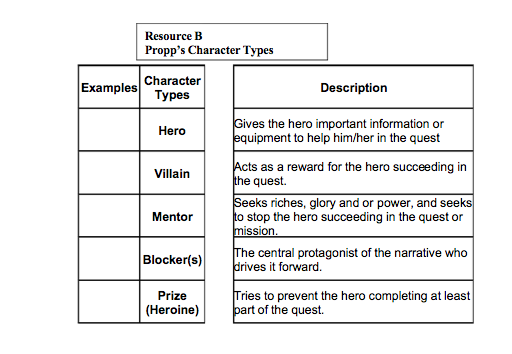
Next lesson: Genre and Character Types (simplified Propp's theory)
ALSO, AS IT TURNED OUT,  AN OBSERVED LESSON FOR THE DEPARTMENT REVIEW.
I will discuss this further in part b)...
I over-prepared this one because it was Review Week and Friday by then, and I still hadn't been seen (could have been any lesson from Wednesday to Friday).

The lesson went well...
... But as ever, I lost my common sense... Anyway, more on that in part b). It worked well until the last activity which was one too many and students still wanted to write about character roles etc. The irony is that THEY WERE DEMONSTRATING LEARNING RIGHT THERE, using the terminology and everything... AND I MOVED THEM ON! WHY? I just do stupid things when I'm being observed, particularly by staff I admire.

The lesson was a Good overall with a lot of "Outstanding" features but it was felt that a few of my students did not make outstanding progress. (I had 9 on SEN list, 7 for Behavioural issues, one a very recent managed move... So really, I'm fairly happy with the result)

Here's the outline of the lesson - and on the PPT below, it's from slide 10 to 24 (with a few extra slides about Ofelia which belong to the previous lesson).


Progression Sheet Pans Genrenarrative
(I had added the SOLO symbols)
I couldn't find post-its for the Exit Ticket plenary before the lesson but a colleague had some heart-shaped ones (how very Gothic!):

Next: More on Genre - Hybrid features 

Preparing to write an essay-type response about the genre of the film.

I won't go into detail as it is fairly obvious. We brainstormed generic features of Fantasy and Gothic, then students added to their lists using the Wordle below.
The Venn diagram was used to decide which features applied to the film. I'm not sure it was needed actually. It seems a bit superfluous.

Students worked well however and started gathering plenty of evidence from the film. We managed to watch another short extract as well.
Venn diag
Genre Conventions End of Unit Progression Sheet(It's gone a bit funny-looking in the process)


The students started their essay at home and completed it in the next lesson. But we decided that we could do much better so spent one more lesson self-assessing after listening to some examples of work at different levels of success. The students thought they needed the whole of the rest of the lesson to redraft and improve.

Finally, the last lesson before half-term arrived (last lesson on the Thursday). We watched the end of the film, stopping here and there to discuss narrative developments.  All students asked to stay behind to watch and discuss the ending! I relented, knowing I would need to apologise to their tutor for their 15min' lateness. But they simply needed to talk!!!

So altogether a not unsuccessful string of lessons. The essays were good and the students begged to watch an extraordinary film which is in Spanish with English subtitles!

Thursday, 2 August 2012

Year 13 - Hexagons for exam prep

Preparing for the Theory exam. Topic: We-Media and Democracy 

We've worked hard, we've struggled along the way...
I've made (too many) resources available, including on the Critical Perspectives  blog there and the We Media and Democracy scoop.it page here.

Drawing everything together is no easy task. So many theorists and so many case studies, so many key points and other things to remember for the exam...
We have done essay plans as a class for several questions but it is difficult to jump from a plan to a competent essay, so I thought I might try the hexagons again.

Starter: Just a minute in teams (pairs) - Topics included: convergence, citizen journalism, democracy, Henry Jenkins, digital determinism, public sphere (quite random)

Then time for exam practice - I settled on "To what extent do new media enrich democracy?"
I distributed blank hexagons. Given that students have to explore 2 'areas' in 60 min in the exam, I split the topics between teams - they would focus on either Social Media/Citizen Journalism or Creativity/Prosumers

On hexagons, they started by writing down key ideas, media, theorists and case studies.
Then they started linking them together.
After a few false starts, they got into it and were increasingly happy with their "branches", though on reflection all had 'weaker' areas or were unhappy with the way they had positioned certain things in terms of the structure. We agreed that it's better to struggle with the flow of the piece now than in the exam room.

Once hexagons were stuck down, pairs filmed themselves talking through their plan and connections.
One of them is below:


Short extract from M. and J.'s "talk-through"

The pair filmed on the iPad (so easy) whilst others used the other cameras... Cue problem with the Media drive on the Macs and the editing got nowhere but we could watch the footage on the camera.

The good thing is that gaps in knowledge and understanding are EXPOSED - nowhere to hide them. I actually had to prompt another group quite a bit through theirs as they were a bit stuck after 3 minutes.
What needed to be revised / consolidated / researched further was obvious.

Ideally, the task set was to watch through the vids at home (from the blog there) and critique through comments before the next lesson. That did not happen. I had already lost a third of students to other exams and re-sits, and most of them had some more exams that week.
We could however watch through them again and simply talk through strengths as well as issues and shortcomings, and address the latter.

I need to do this a little earlier next year...

Students found the exercise really useful and great prep for essay writing. Practice questions (the few that were handed in) were good. Let's wait for the 16th August...


Wednesday, 18 July 2012

Year 9 Poetry - Final Week of Term AKA..."Assessment Week"

Right... Assessment Week... Way to finish the year!

In fact, it worked out fine.
GCSE link unit, poetry exploration climaxing in group exploration of an unseen poem and presentation to class: a reading of it and  'teach' the poem. Higher ability groups told to link to other poems (studied together) and level 7 students told to compare / contrast with at least 1 other poem.

I clearly went for ability groups there. Each group had to explore and analyse a different poem.

I used some of the poems from the old NEAB specs (though most feature in the AQA Anthology it seems) as the unit also focuses on language use.

I also went for the whole SOLO thing this time.

PREVIOUSLY: Discussed meaning of culture, identity etc...
We looked at immigrants from the 40's onwards (the vast majority of students would have immigrant parents and I am one too) watching old news reel, listened to extract from The Arrival of Bright Eye (LOVE IT),  studied Island Man (in detail as they had to write a last essay for Progress Check 6...) and  Search for My Tongue.

The latter poem was used to create this model to show SOLO levels of understanding and act as a model.

SOLO Model (adapted from existing resource)

Poems included, in order of "ability" (vaguely):
Mum, Dad and Me 
Unrelated Incidents extract... Not the 6 O'Clock News
Night of The Scorpion
Not my Business
Presents from My Aunts in Pakistan
Limbo
Blessing
An Old Woman


Groups were directed to sit as per the seating plan. Groups were given a folder each with a range of resources including some of the slides from the ppt, including the SOLO progression/differentiated LOs, a loose grid for those who are stuck with what to do with a poem, some more specific questions on their respective poems (mostly used in lesson 2 for most groups), a copy of the 5 Learning Stages model (see above) and clear copies of the poems of course. I added a couple of post-its for the starter and plenary=exit ticket showing progression).

At the end of the first session, each group set themselves homework, such as memorizing some of the lines doing further reading on the poem or the poet, or annotations/answering specific questions.

Before the 2nd session, I added more specific questions on themes in each folder. Students could also have access to GCSE notes for part of the lesson but because it was limited, they had to choose WHEN it was most needed to support and stretch their understanding.

Buzzing for 2 lessons...

Extra support was given to the first group: I had prepared picture cards to help them visualise the images in the poem Mum, Dad and Me and to split them in 2 to see the contrast between Jamaica and London. I DID HAVE TO EXPLAIN THE WORD CONTRAST but it was great as it was THE word they needed at that point (they were using 'opposites'). They then used some questions I provided at that point to dig deeper and finally a writing frame to analyse the poem more closely, particularly some language features.
The group with the Scottish poem were given a recording of it and of Leonard talking about his poem.

All groups were asked after a while to decide which pictures from the pack cover was/were relevant to their poem as a quick understanding check.

Great presentations in the last 2 lessons, filmed, with my 2 level 6/7 groups delivering a magnificent lesson on their assigned poems, the most able group (studying An Old Woman) drawing interesting and detailed comparisons and contrasts with Blessing (I did provide a frame to help them with that).

Happy teacher - Brilliant progress for all.


Tuesday, 17 July 2012

Talking to the staff - 10 minutes of hell

Well, it had to happen at some point. My colleague and I were asked to talk about something we worked on this year in front of the whole staff in a 10 min slot on Wednesday morning.

We decided to talk about hexagons having used them in several lessons and in different ways, and having read many great blogs from fantastic tweachers. We also both experimented with SOLO and some of the lessons were delivered in that context... but neither of us feels expert enough on SOLO and a 10 minute-slot calls for 1 main idea.

So we pulled together several pictures we took in lessons and decided to simply talk through some of the things we'd done. I added a few pictures borrowed/stolen from other teachers' blogs to suggest that hexagons can be used in other subjects beyond English and Media. They can be used to encourage rich discussion and to allow students to make links between different bits of content/knowledge. The focus was also to make students work and test ideas more independently of the teacher and to rehearse ideas / try out vocabulary before an extended written response.

We have both felt that classes responded REALLY well and produced good written work. We also loved circulating and listening to some fab contributions, challenging and stretching as we went...

I hated talking to the whole staff though. It took me a whole hour afterwards to go back to a normal heartbeat. Can't stand the idea that anyone would think I am arrogant enough to dare to lecture them on anything...


Tuesday, 10 July 2012

Useful resource for planning LOs / progression

Someone brought this into the office today. It's another way of planning for progression / planning LOs.

In comparison, this is the SOLO verbs (as found on Tait's Prezi @Totallywired77) and very similar to David's grid in his book (@LearningSpy):

Finally, this is another slide from tait's Prezi where SOLO and Bloom's taxonomies are compared (useful to keep)

Thursday, 21 June 2012

Gothic - Exploring author's craft

Year 9 - Gothic Unit: Mary Shelley's Frankenstein

It looks like a bit of a boring one this one but it works so well every time!
This is a follow up lesson to reading/discussing/hot-seating characters from the extract in Ch.4 when the Creature awakes.
The overall objective is to analyse the author's craft and explain the ways in which Shelley manipulates our feelings, makes us empathise with the characters.
This comes afterwards to consolidate and stretch students' understanding of narrative techniques and to encourage them to deploy similar tricks in their own writing. It can lead to a Reading piece as well though we did it more informally this year, having done a BIG piece recently. (PPT from previous year)

We'll also keep doing the next piece in which the events are re-told from the creature's perspective (minutely re-told following the structure of the original - great for inference as well!). It also allows me to distribute a copy of the chapter in which the creature takes over the narration to all who want to read it (usually quite a few!)

Here, the idea is simply to focus on matching narrative techniques to parts of text - in pairs, armed with scissors, glue and pens to annotate further once it's all stuck down. Straightforward lesson, straightforward plenary, much discussion generated by the different examples the students find, how they justify their choices, how effective the techniques are, and also how old-fashioned... Some always argue that today's authors wouldn't use some of the really long sentences that are found in the extract for instance.